John’s Table
1. The 7 Points of My Politics
I consider myself a
- Christian Democrat & Techno-Distributist, while also being in balance a(n)
- Atomic Libertarian-Conservative,
- Neoclassical Liberal & Hayekian Socialist,
- Anarcho-Capitalist: Catacomb Agorist, & “Silicon Valley Exit" Cypherpunk.
- Minarchist Anarcho-Monarchist
- A student of Political Hesychasm and Roman Orthodoxy which can thrive in any pluralistic political entity, without seeking to build a particular civilization, but heals civilizations and cultures by healing persons.
- I hold it all with Metamodern Oscillation in all of the above
Christian Democracy & Voluntary Techno-Distributism
Christian Democracy https://en.wikipedia.org/wiki/Christian_democracy
A moderate Social Market Economy is compatible and supportive of Libertarian Economics.
Solidarity and Subsidiarity should be sought as a function of Sobornost.
John Medaille has written a book and given a talk that demonstrates how distributism provides practical solutions to many of our problems.
Techno-Distributism is a Distributism that has left the outdated agrarian metaphor behind in favor of the ways in which new technologies (e.g., desktop manufacturing) lend themselves to the distributist model. This was first proposed in Make magazine. Personal means of production in this era has less to do with acres of land and more to do with how much compute power and data one has.
Schumacher's "Small is Beautiful" describes several desirable features of a distributist system.
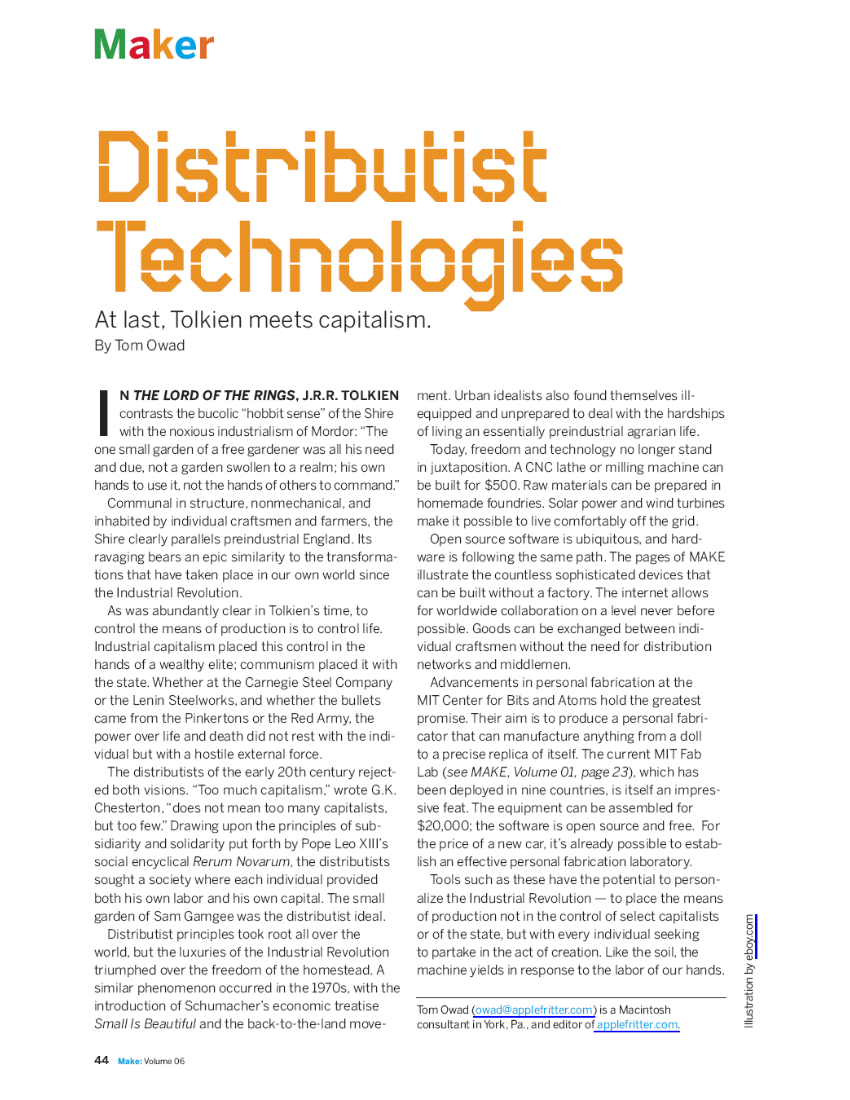
Distributism should be voluntary rather than a feature of central planning. A general description can be found on Wikipedia.
Distributism is a friend of Decentralism which is discussed regularly in the Front Porch Republic. It also proposes realistic environmental solutions.
Atomic Libertarian-Conservatism
Both Libertarian and Conservative thought get into trouble when extrapolating beyond basic (atomic) principles. Extrapolated Libertarianism feeds into personal selfishness and corporate rule, the latest manifestation being the dictatorial and fascist “neo-reactionary” movements.
Conservatism gets stuck with the Thomistic errors of natural theology and natural law. This had led in recent times to an externalized morality and obsession with culture wars.
-
(See Wikipedia)
-
The Atomic Definition of Libertarianism is:
- The Non-Aggression Principle
- The Principle of Self-Ownership
- The Contract as the atomic basis of law
- None of these are absolute, with important exceptions in community. Libertarianism gets into trouble upon extrapolation, e.g. trying to become a complete political or economic theory, which it is not.
-
Atomic Conservatism best follows Kirk’s big 10, but a proposed Patristic modification is the rejection of Natural Theology, Natural Law and "Culture Wars" as a means to an end.
Neoclassical Liberalism and Hayekian Socialism
- There is an introductory article on Wikipedia.
- The best discussions are at the Bleeding Heart Libertarians blog, including a discussion of Hayekian Socialism
- The book “Markets, Not Capitalism” is here in PDF for free. You can also buy it and read descriptions at Amazon
- In view of encroaching corporatism and jobs being moved to AI, I have drifted further left, and believe that the state should provide a Universal Basic Income, a strong social safety net and welfare system, including medicine. Corporations and the wealthy who benefit from AI and other innovations that eliminate jobs should contribute to the cost of this. As such, I support Social Democracy, but not Democratic Socialism. Free Market Entrepreneurs are essential.
Anarcho-Capitalism: Catacomb Agorism, Exit & Cypherpunkdom
Agorism is described on Wikipedia, and a more complete introduction can be found at agorism.eu.org. I consider the practice of Agorism and/or Counter-economics to be mainly legitimate under catacomb conditions, but some practice and preparation is always necessary. Catacomb economics is related to some ideas of Christian Anarchy.
“Silicon Valley Exit” and Cypherpunks
“Silicon Valley’s Ultimate Exit” can be watched on YouTube This is a meditation on the larger concept of Voice Vs. Exit.
The “Benedict Option” is also a form of Exit. While I reject much of Dreher’s thinking, the core concept has some validity. Exit has some bad manifestations. Dreher’s version, mixed as it is with Nativism is one, but the worst is the Dark Enightenment, which is corrupting Libertarian thought. Unfortunately, Mr. Srinivasan of the above video appears to be influenced by this. I otherwise like some dimensions of the network state as a digital catacomb.
A network state is a highly aligned online community with a capacity for collective action that crowdfunds territory around the world and eventually gains diplomatic recognition from pre-existing states.
Cypherpunk philosophy is well described on Wikipedia
Minarchist Anarcho-Monarchism
I have always acknowledged the monarchic and symphonic principle as a traditional ideal which cannot be dismissed. However the ideal is unlikely to find any metamodern fulfillment in anything but a longing that oscillates with a desire for freedom. Even a constitutional monarchy creates a symbol of the longing for symphonic harmony.
Tolkien best described this as is summarized here.
“When royal authority falls, and the people everywhere institute self-government (republics, democracies), then there will be room for the Antichrist to act. It will not be hard for Satan to prepare voices in favor of renouncing Christ, as experience showed during the French Revolution. There will be no one to pronounce the authoritative veto. And so when such regimes, suitable for disclosing the Antichrist’s aspirations, are instituted everywhere, then the Antichrist will appear.”
—St. Theophan the Recluse
On the other hand:
“Christianity is neither monarchical nor republican. It does not care about governments, but about the spirit living in them. That government is best which is fullest of the Christian spirit.’”
— St Nikolai Velimirovich
While the monarchic principle is normally autocratic and not constitutional (see quote above), even autocratic monarchism has a degree of constitutionality (See the wiki on the Zemsky Sobor).
Roman Orthodoxy & Political Hesychasm
Roman Orthodoxy
My concept of geopolitics follows a concept of Roman Orthodoxy, a church which is unified among “πάντα τὰ ἔθνη” - all of the groups of peoples. Just as the Roman Empire was made up of many peoples who all were citizens, so too the church was made up of all peoples. This means that nationalism, nativism and such ideas are out. Even revered ideas such as “the Third Rome” must be taken lightly, and patriotism must take a back seat to the kingdom which is not of this world. Ethnophyletism is rightly rejected as a heresy. I agree with the missional worldview expressed in the essay by Gordon Aeshliman titled “We are World Christians.”
Political Hesychasm
Political Hesychasm is best described by Romanides and Yannaras. One description:
“Romanides’ most pertinent contribution is his three-level theory of justice. The first level is that of the law. The second level is of those who have been purified and illuminated. They do not have the need for the law. The third, and highest, level is of those who have experienced the glory of God. Here the passions are stilled, and the person lives in perfect harmony with God and creation. This is possible to achieve in the church, which is the communion of transfigured people living in but separated from the state. Religious liberty is not necessary for the church to function. More detailed treatment of Romanides’ thought must wait for another occasion.”
– https://publicorthodoxy.org/2023/12/07/political-hesychasm/
Dostoyevsky in “The Brother’s Karamazov”:
You are completely misunderstanding it,” said Father Païssy sternly. “Understand, the Church is not to be transformed into the State. That is Rome and its dream. That is the third temptation of the devil. On the contrary, the State is transformed into the Church, will ascend and become a Church over the whole world—which is the complete opposite of Ultramontanism and Rome, and your interpretation, and is only the glorious destiny ordained for the Orthodox Church. This star will arise in the east!”
Being against “Christian Civilization” except as a side effect of social healing
https://www.firstthings.com/article/2025/01/against-christian-civilization
Metamodernism
There is an article about this on Wikipedia.
Metamodernism is one manifestation of a post-phenomenological restoration of Western thought from the metaphysical/ontological prison that it was in from Aquinas until Kant. Attributes of Metamodernism in a Christian context include thought which is:
-
Post-Metaphysical/Ontological
-
Apophatic
- Non-identification of divine signifiers with the signified. Just as reverence for an icon passes to its prototype, so too, reverence must be for the signified and not the signifier in names and concepts.
-
Initially Existential / Phenomenological
-
Symbols are interpreted phenomenologically as patterns of awareness (e.g. as in “Most of the time the earth is flat” by J. Pageau)
-
Empirical
-
Conscious
-
Integral
-
Personal
-
Prophetic-Conciliar-Traditional
- Narratives are tools which attempt to transmit intersubjective experience, fulfilled in Theoria and Theosis.
Someone said that to be spiritually consistent, will lead one to be politically inconsistent, hence the need for metamodern oscillation.